Showing posts with label creative nonfiction. Show all posts

Guide to riding the bus in Peru & Bolivia

Wednesday, August 27, 2008

We didn't know it at the time, but our first luxury bus experience in Peru would spoil us for the rest of our 5 week trip. It provided all the things expected of a coach bus in America:

  • It left on time
  • It did not randomly let passengers on or off in the middle of nowhere
  • It went from point A to point B without unnecessary layovers
  • It had a functioning bathroom
    Not only did it meet all of the seemingly standard criteria listed above above, it went above and beyond the call of duty by:
    • Providing a snack
    • Offering blankets to cold passengers, with complimentary tuck-in service!
    • Tagging and securing luggage
    • Showing a movie appropriate for all ages
    • Showcasing the rare, fold-down legrest
    From that point forward, we never quite knew what we would get. And tragically, the bar had been set way, WAY too high.

    In Peru and Bolivia, where most people do not own a car, the main method of transportation is via bus. In fact, it is not uncommon to look out the window at a sea of vehicles and not see a single car. Crowded mini-buses and taxis dominate the city streets.

    Between cities, there are coach buses of varying price, quality, and comfort. Unfortunately, the relationship between the three is spotty at best, if not completely random. Be prepared. It can't hurt to ask the relevant questions at each ticket counter as you decide which of the ten different bus companies serving your destination you will entrust your happiness to for the next 12 hours.

    But, it can't help much either.

    In these countries, where people are generally known for their friendliness, honesty, and kindness, it can be downright soul-crushing to find out after several hours of bouncing along uneven, dirt roads that the handle to the bathroom door has been removed. Intentionally. Again. Despite assurances to the contrary.

    Eventually you realize that some buses don't even pretend to have bathrooms.

    Having to clean the bathroom, it would seem, just doesn't contribute enough to the bottom line. Nor does providing heat, even when nighttime temperatures drop well below freezing. The locals understand this, and embark carrying winter coats, hats, and wool blankets. Balled up, shivering in the fetal position, with all four limbs pulled into my only fleece, I couldn't help but wonder about all the potential revenue they were losing. I would have paid dearly to rent even one of those cheap airline blankets.

    The first time it happened, I told myself it was an especially cold night. The second time? Just the particulars of the terrain we had driven though. But the third? I cursed my optimism and bought a nondescript gray wool blanket, which I begrudgingly crammed into the top of my already full backpack for the remainder of my time in Bolivia.

    If there were a manual entitled "The ins and outs of busing in Peru and Bolivia", it would give advice like:
    • Remember not to spend your last 30 cents until after paying the required departure tax
    • Save an additional 30 cents: you will need it for the surprise bathroom break 6 hours from now
    • If the bus stops for a layover, do not leave your seat unless you can have someone save it for you
    • If an old lady sits on your armrest, deal with it. She isn't going anywhere
    • If a man stands up in the aisle and speaks for more than 10 seconds, do not bother paying attention. Crank up your iPod, he'll be blathering on about God for at least another 15 minutes
    • Only tourists sit in the front row of the upper deck. The panoramic windows don't provide protection from the cold. Besides, if the views aren't blocked by the giant lettering on the front of the bus, they will probably ice over shortly after sunset.
    • "To be safe, the bus travels slower at night" is code for: "We will be making a two hour layover in a town of three thousand people at 1 am for no apparent reason"
    And the list goes on.

    Buses however, are the great equalizer. It may be one of the few times you find yourself side-by-side with the locals, having paid the same price for the privelege. I can only imagine this happens because, unlike places like Machu Picchu, there is an unbelievable amount of duplicate services shoulder to shoulder with one another.

    In the U.S., your choice is essentially limited to a few different time slots. Pick one, and off you go. Greyhound awaits. Try walking into a bus station where thirty different people from twenty different bus companies are all yelling "Puno, Puno, Puno, Puno" in your direction.

    Eventually, you will get used to the long, bumpy nights on an unpaved road for seven straight hours. Eventually, the dust billowing off an identical bus, traveling the identical route, on the exact same time schedule won't annoy you. Bus already full and stopping to pick people up on the side of the road to stand in the aisle next to you for several hours? No worries, this is how you travel now. You may even be able to convince yourself that the younger passengers aren't paying attention to that movie about terrorism, capture, torture, and worse.

    But this is how it's done here. If you want to jolt yourself out of the daily lifestyle, travel in comfort, style and speed on a plane. But if you want to be a local, see the country from ground level, go easy on your wallet, and test your patience (and bladder), take a bus.

    I'd lend you my wool blanket, but it's in the closet, awaiting my first houseguest of the winter who dares to ask: "What was your honeymoon like?"
    T-shirts, cocaine, and kindness in Cusco

    Sunday, August 17, 2008

    Cusco, Peru

    Brushing past a horde of scurrying schoolchildren, I passed through the narrow archway. In an instant, I had gone from blending in, to the obvious foreigner. As I moved upstream through the crowd, the wind whipped against my skin and it became clear - I was the only idiot wearing a t-shirt.


    ---

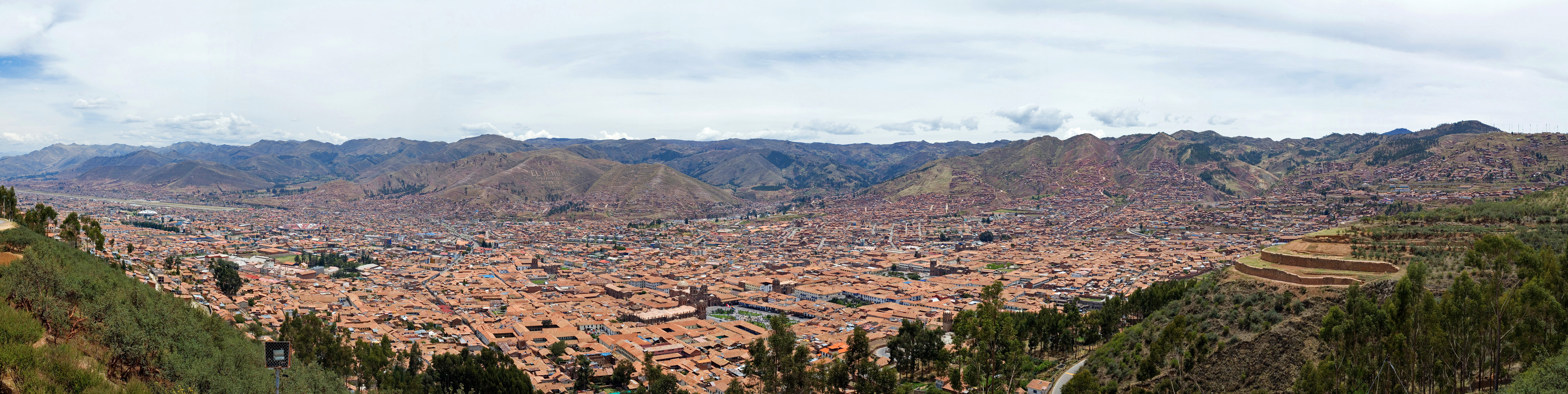
    All the travelers go to Cusco. Why? Because it’s the staging ground for Machu Picchu, and why else would you visit Peru? Well it turns out there are plenty of reasons, and Cusco itself is one of them. This modestly sized city in the Sacred Valley has tripled in size to around 350,000 in just the last 20 years, no doubt because of the massive influx of tourists stopping through on their way to the ancient Incan city in the clouds.

    (image courtesy of Cacophony)

    At first glance, it’s almost too perfect. Beautiful, hilly cobblestone streets in every direction. Artistic nighttime lighting and shadows straight from a Hollywood set. A group of children doing group aerobics in a public square.


    However, if you confine your visit to the main streets surrounding the Plaza de Armas, Cusco
    can feel like a Disneyland of shameless sales pitches. Every establishment within a 2 block radius (amounting to…hundreds?) has someone stationed out front just dying to sell you a meal, tour guiding services, international calls, or even cocaine. [Aside: While feigning shock and disgust, I was secretly flattered to be “cool enough” to have received the offer]. The annoyances are easily ignored (I suggest: “Ya comi”. Translation: “I already ate”) but there are a few areas in particular where you’ll find it hard to carry on a conversation uninterrupted.

    Wander just a few blocks in any direction, and traveling abroad will feel like just you always imagined it. Get lost in a local market selling food you’d be afraid to eat. Peer through ancient doorways into secret courtyards and twisting hallways. Run your fingertips along an Incan wall, centuries old, and gaze up at the modern structure built atop it.

    And of course, just when you think someone is trying to sell you something, remember that Peruvians can be downright over-the-top accommodating and helpful. Which brings us back to me in my t-shirt, at night, at 10,000 feet. In the middle of winter.

    Aware of my own condition, suddenly, I was my own hero. Yeah, that’s right. I was born and raised in a little place called Wisconsin. Ever heard of it?

    Inner monologues don’t make public heroes out of idiot tourists.

    I would survive the arduous trek back up to my hostel, where, despite the promises made, my laundry was 30 minutes late. With barely enough time to adequately clothe myself, my wife and I hurried down to the travel agency to pick up our bus tickets.

    And again, despite the promises made, no tickets.

    (image courtesy of orignal)

    With less than 25 minutes to spare, the woman at the agency grabbed us and ran out the door. Here we were, two comparatively giant white people with enormous backpacks, being dragged through the streets of Cusco by a woman just barely over four feet tall.

    If that wasn’t bad enough, I kept losing her in the crowd: a passing loud and colorful street parade of children, cruelly of identical body proportions to our scurrying hostess.

    Figuring she was driving us to the bus station herself, I was surprised when she hailed a cab. Figuring she was making sure we would be driven to the right place, I was surprised to see her in the back seat, pinned beneath a pack several times her size. She didn’t drop us off at the bus station either, or let us pay for the cab. Figuring she was simply showing us which gate to head towards, I was surprised to see her paying the departure tax for our tickets. Then, after a hasty and bewildered goodbye from Janet and I, she shoved us off through our gate, and disappeared into the crowd.

    (image courtesy of Kaldoon)

    City on the edge: Lima, Peru

    Monday, August 11, 2008

    "It hasn't rained in over 2,000 years," he told us. That couldn't be true, could it?

    It might. Based on our small anecdotal sample, it hadn't rained at all in our five weeks in Peru or Bolivia. Heading down to the deserted oceanfront (where pollution problems discourage all but the most enthusiastic of surfers), you can see that it must be true. The edge of the city stands precariously atop cliffs that appear ready to melt into the Pacific Ocean at the even the slightest hint of rain.


    Yes, those are just tiny stones held together with dirt.

    Seemingly every aspect of Lima is either an exercise in extremes, or one of barely stable equilibriums.

    While the weather is moderate (average highs in the low 60's year round) and continually overcast, heavy sustained rains would guarantee mudslides and housing collapses. The population has increased approximately 15-fold in the last 65 years. Services and development cannot seem to keep up with the influx of new residents.

    (image courtesy of teague03)

    And in the 17th and 18th centuries, it was almost completely destroyed by earthquakes. Three times.

    After just two cab rides, the extremes became painfully clear.

    On one trip from the airport, we denounced Lima as a sprawling slum. Barren, dusty, and often seemingly abandoned, there would be no reason to ever visit it again. This wasn't just a poor area of a modern city, these were mud and brick shanty towns woven together with crude dirt roads.

    Returning to the tourist district of Miraflores several weeks later, we took a different route through town. Wide, tree lined boulevards. Green grass everywhere. Casinos. McDonalds. Sharply dressed white collar workers. The glimmering skyscrapers of the financial district, San Isidro. Had we arrived in the wrong city?

    (photo courtesy of PromPeru, by way of Wikipedia)

    Despite being a giant metropolis, the people are exceedingly friendly and helpful. The hosts throughout all of our accommodations bent over backwards to provide us with local insights and made us feel like part of their family. More than once I had to speed up the conversation after my eyes glazed over from well intentioned "help overload".

    At one point, our taxi driver pulled over to ask a police officer on a motorcycle about the location of a particular street. He didn't know offhand, but quickly called a friend on his cell phone, and was able to give us an approximate location.

    I guess you can't really fault our driver for not knowing one particular street, given that it was 15 miles from where our ride started. (It turned out to be only 1 block long!)

    Still from the shanty towns surrounding the city, to tourist district of Miraflores, to the swanky towers of San Isidro, and the few remaining historic structures (like the Cathedral in Plaza Mayor):

    (photo courtesy of mannover)

    ...you never quite know what you are going to get with Lima.

    Sadly, this makes it a hard sell for the casual traveler. It is easy to feel like you have run out of things do to within the first 24 hours, but you'll miss the complete picture. If you understand and appreciate the nuances of it's history, culture, and extremes, this 'city on the edge' might just surprise and delight you.

    Just pray that it doesn't rain first.